|
|
樓主 |
發表於 23-6-2007 13:10:41
|
顯示全部樓層
西貢 無線電獵狐
<p class="MsoNormal" style="text-align: center;" align="center"><b><span style="font-size: 16pt; font-family: Dotum;" lang="EN-US">Rapid RDFing<br>
An Introductory Scouting Activity<o:p></o:p></span></b></p>
<p class="MsoNormal" style="text-align: center;" align="center"><b style=""><span style="font-size: 16pt; font-family: Dotum;" lang="EN-US">By
Stan Pozerski KD1LE<o:p></o:p></span></b></p>
<div class="MsoNormal" style="text-align: center;" align="center"><b style=""><span style="font-size: 16pt; font-family: Dotum;" lang="EN-US">
<hr align="center" color="#aca899" noshade="noshade" size="1" width="100%">
</span></b></div>
<p class="MsoNormal" style=""><b style=""><span style="font-size: 16pt; font-family: Dotum;" lang="EN-US">I was recently asked to
participate in a Boy Scout Camporee and provide a demonstration program of some
aspect of Amateur Radio. There was to be a HF station and possibly some other
Amateur Radio activities available. Being an active Fox Hunter I thought I
could do radio direction finding independent of anything else so I threw my
gear in the car and headed off that Saturday morning not knowing what to
expect. The first thing I saw upon arriving at the site was the four vehicles
in the middle of the field stuck in the mud. So I parked on the road and walked
over to the HF station that was being set up. It was at the edge of a small
stand of trees about seventy-five feet across. This seemed a reasonable
arrangement so I decided to plant the fox on the opposite side of the stand in
the tall grass at the base of a few small trees. Returning to the HF station I
waited for the fox to transmit then set it to one-minute intervals for the
thirty second transmissions to keep things active. <o:p></o:p></span></b></p>
<p class="MsoNormal" style=""><b style=""><span style="font-size: 16pt; font-family: Dotum;" lang="EN-US">I started to develop a
story line that would tie in to scouting to get the interest going. I pulled
out my fox hunting gear, hung the compass around my neck, map and HT in hand
(see above). It was a quick attraction. As the groups of scouts arrived I
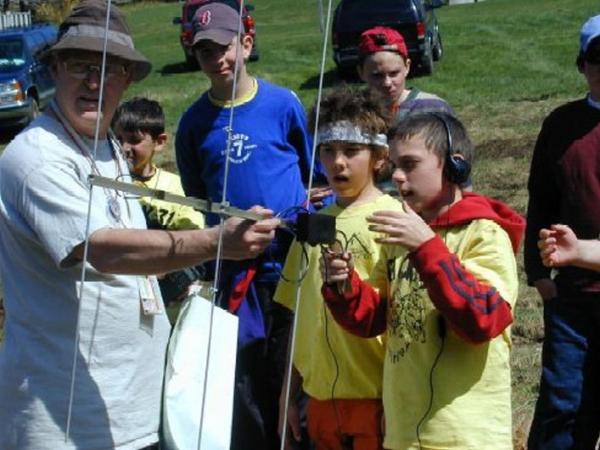
handed one of the scouts the custom antenna with a FoxFinder (see QST April
2001) attached, and started the talk with how fox hunting was like Orienteering
having map and compass work with the added difficulty that you didn't know were
the end point was. Since the FoxFinder is an audio signal strength indicator it
was easy for the kids to swing the antenna and hear the signal change without a
lot of tutoring. With one or two sweeps of the antenna virtually all of them
could give a good direction. Quickly taking turns with the one-minute cycle we
projected virtual bearings into the trees. <br style="" clear="right">
<o:p></o:p></span></b></p>
<p class="MsoNormal" style=""><b style=""><span style="font-size: 16pt; font-family: Dotum;" lang="EN-US">After a couple of scouts
got bearings I moved them part way around the grove and gave a few more scouts
a chance with the antenna and FoxFinder. <o:p></o:p></span></b></p>
<p class="MsoNormal" style=""><b style=""><span style="font-size: 16pt; font-family: Dotum;" lang="EN-US"><br style="" clear="left">
<o:p></o:p></span></b></p>
<p class="MsoNormal" style=""><b style=""><span style="font-size: 16pt; font-family: Dotum;" lang="EN-US">After three or four
locations we estimated a spot where the bearings crossed and walked to the
location. Here I instructed the scouts in fox hunting etiquette. Among other
things this includes never revealing the location when you think you spot it
until every one gets a chance. Even though we were within ten feet at this
point no one found it accidentally. After another half dozen tries from within
ten feet the location of the fox was revealed. A couple of scouts were able to
correctly identify the disguised transmitter, which was remarkable as there was
other "junk" around and they had no idea at all what they might be
looking for. <o:p></o:p></span></b></p>
<p class="MsoNormal" style=""><b style=""><span style="font-size: 16pt; font-family: Dotum;" lang="EN-US">I did this with ten groups
of four to eight scouts in about fifteen minute intervals without difficulty
and not losing any to other diversions. <o:p></o:p></span></b></p>
<p class="MsoNormal" style=""><b style=""><span style="font-size: 16pt; font-family: Dotum;" lang="EN-US">The scouts caught on
quickly to the principle of directional antennas and audio signal strength
readings. <o:p></o:p></span></b></p>
<p class="MsoNormal" style=""><b style=""><span style="font-size: 16pt; font-family: Dotum;" lang="EN-US">The signal strength
indication by tone variation was much easier than dealing with radio S meters
and attenuators. The near constant activity kept them from losing interest. <o:p></o:p></span></b></p>
<p class="MsoNormal" style=""><b style=""><span style="font-size: 16pt; font-family: Dotum;" lang="EN-US">If I were to do this
again, I would prepare some schematic maps of the area and have each scout plot
some of the bearings the group generated. This would combine some compass
skills with basic map skills. Each scout would take home his copy of the map as
a memento. And, of course, I would pre-print the blank maps with some Web
addresses to learn more about Amateur Radio. <o:p></o:p></span></b></p>
<p class="MsoNormal"><b style=""><span style="font-size: 16pt; font-family: Dotum;" lang="EN-US"><o:p> </o:p></span></b></p> |
-
|
 樓主: VR2GY